Title Tag Optimization: Length, Patterns, Rewrites
Google rewrites a large chunk of titles, and the wrong pattern can bury a page at position 11-13. On enzymes.bio, 7,950 organic clicks/month and 557,000 impressions/month still left a 1.4% CTR, which makes title tag optimization a direct revenue lever.
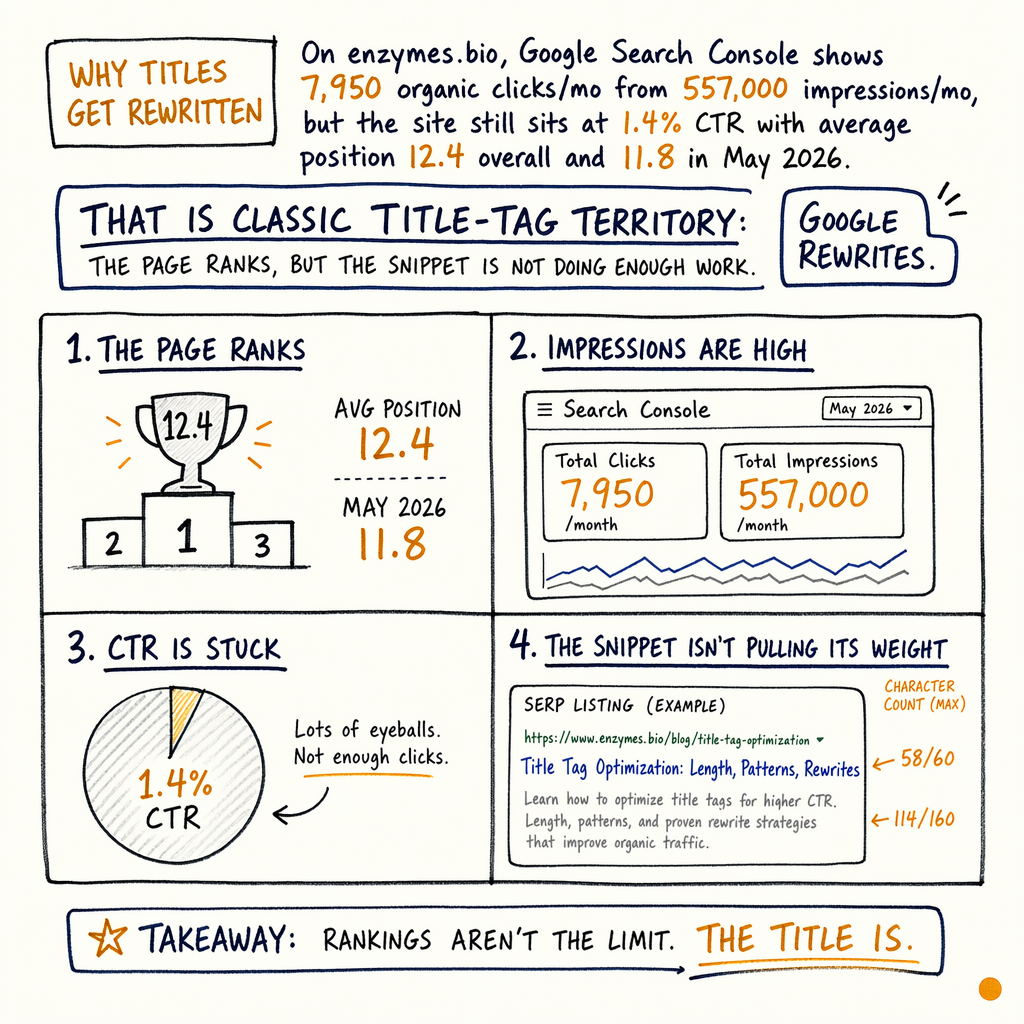
Why titles get rewritten
On enzymes.bio, Google Search Console shows 7,950 organic clicks/mo from 557,000 impressions/mo, but the site still sits at 1.4% CTR with average position 12.4 overall and 11.8 in May 2026. That is classic title-tag territory: the page ranks, but the snippet is not doing enough work.
Google rewrites titles when the page title is vague, duplicated, too long, stuffed with keywords, or mismatched with on-page headers. The result is usually a different title in the SERP than the one you wrote. If you want fewer rewrites, the title needs to match the page topic, the query pattern, and the intent signal on the page.
The problem is visible in Performance › Search results, where queries with strong impressions but weak CTR tend to cluster around positions 8-15. That is where a better seo title tag can move the click curve before the ranking even changes. See CTR by position if you want the math behind that curve.
Title length that fits
Desktop pixel target
Aim for roughly 580px on desktop, not a raw character count. That usually lands around 50-60 characters, but wide letters like W and M eat more space than i or l.
Mobile title behavior
Mobile results truncate sooner. If the core query and value proposition are in the first 35-45 characters, the title still works when the rest gets clipped.
Put the topic first
Start with the main phrase when possible. A title tag best practices layout usually puts the primary keyword first, then the modifier, then the brand or site name if needed.
Use one intent signal
Include one clear signal: price, guide, comparison, location, or category. Too many signals turn into noise and trigger title rewrites.
Best title tag format
The best title tag format is not a rigid formula. It is a controlled pattern that preserves meaning, fits the pixel budget, and mirrors the page's actual H1. For most pages, use:
Primary keyword | Specific modifier | Brand
That pattern works because Google can still understand the page if it rewrites part of it, and the snippet remains readable. For example, a product page might use Title tag optimization tools | Compare templates | Brand, while a guide might use Title tag optimization | Length, patterns, rewrites.
If the page is commercial, align the title with the page URL structure and internal anchor text. If the page lives in a cluster, make the title distinct from related pages so you do not create self-cannibalization. If the page is content-led, pair it with a matching meta description strategy from meta description best practices.
Rewrite patterns to avoid
| Field | Better | Worse |
|---|---|---|
Length | 50-60 characters or ~580px | 80+ characters with key term at the end |
Keyword use | One primary keyword once | Keyword repetition or stuffing |
Format | Topic + modifier + brand | Comma stack with no clear intent |
Match | Title matches H1 and body | Title says one thing, page says another |
Uniqueness | One title per URL | Same title reused across category pages |
Title rewrite checklist
- ✓
Put the primary keyword in the first half of the title.
- ✓
Keep the main idea visible before the 580px cutoff.
- ✓
Make the title match the H1, URL, and intro paragraph.
- ✓
Remove filler words that do not change intent.
- ✓
Check
Performance › Search resultsfor low-CTR pages with high impressions. - ✓
Compare the live title with the title Google shows in the SERP.
- ✓
Fix duplicates across category, product, and filter pages.
- ✓
Use a distinct title for each language if the site has 35 languages via TranslatePress.
Test titles with GSC
{
  "queries": [
    {
      "page": "/example-page/",
      "gsc_report": "Performance › Search results",
      "metric": "CTR",
      "before": "0.9%",
      "after": "1.6%"
    },
    {
      "page": "/example-page/",
      "gsc_report": "Performance › Search results",
      "metric": "Average position",
      "before": "12.8",
      "after": "11.9"
    }
  ],
  "title_templates": [
    "Primary keyword | Specific modifier",
    "Primary keyword for intent | Proof point",
    "Problem keyword | Outcome phrase"
  ]
}
Inspect title snippets
const title = document.title;
const h1 = document.querySelector('h1')?.textContent?.trim();
const meta = document.querySelector('meta[name="description"]')?.content;

console.log({
  title,
  titleLength: title.length,
  h1,
  metaLength: meta?.length,
  titleMatchesH1: title?.toLowerCase().includes(h1?.toLowerCase() || '')
});
Fix title issues fast
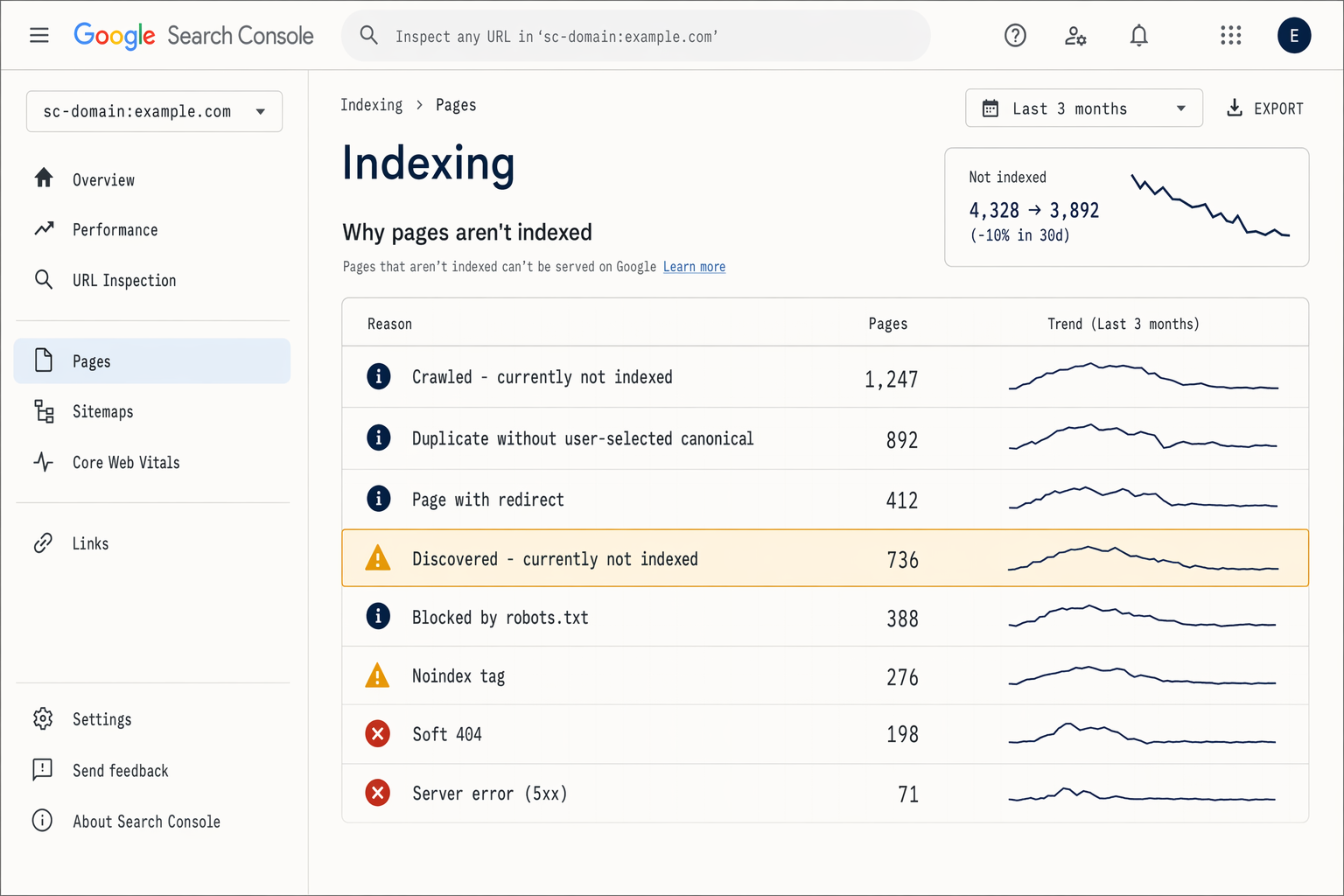
If titles are being rewritten, start with the pages that already get impressions. On enzymes.bio, 16,100 indexed pages and 591,000 not indexed means indexation is not the only bottleneck. The title layer matters because Google can only reward pages it can understand and trust.
Use Indexing › Pages to find pages that are indexed but thin on clicks. Use Settings › Crawl stats to confirm Googlebot is hitting the right templates. Then inspect Links › External links; enzymes.bio has 0 external backlinks, which makes on-page CTR and relevance signals even more important.
If a page is important to revenue, it deserves a tailored title, not a template stub. That is especially true for pages connected to 943 orders to date and $240,809 lifetime revenue at $255 AOV. Title tag optimization is not cosmetic when the click is the bottleneck. If you want a full-page review, start with technical SEO audit.
FAQ
What is the best title tag length?
The best target is about 580px on desktop, which often lands near 50-60 characters. Start with the primary keyword, then trim filler words before you trim meaning.
Why does Google rewrite my title tag?
Google rewrites titles when they are too long, duplicated, stuffed, or poorly matched to the page content. It also rewrites when the H1 or on-page headings signal a better summary.
Should I put the brand in every title?
Only if it fits naturally and adds value. For non-brand queries, the brand should usually go at the end, or be dropped if it harms the core message.
How do I test a title rewrite?
Change the title on one page, then watch Performance › Search results for CTR and impressions over the next crawl and reporting cycle. Keep the test isolated so you can compare before/after cleanly.
Do title tags affect rankings or only clicks?
They mainly affect clicks, but clearer titles can improve query matching and engagement signals. That is why title tag optimization belongs in on-page SEO, not just SERP copywriting.